
RabBarbara - Rabbi Barbara Penzner's blog
Wednesday, March 19, 2014
Why I support the Jewish Labor Committee
Check out KOLOT: Voices for Worker Justice and join us for the Labor Seder on Tuesday, March 25 at Temple Israel, Boston

Thursday, March 13, 2014
I'm Ready for Purim: How about You?

Mardi Gras pin in place: check
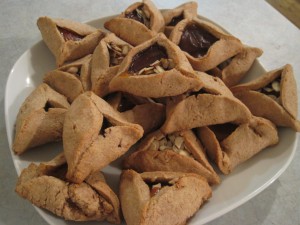
Hamantashen
dough all made: check
Green
face paint: check
Purim
shpiel written, cast, rehearsed: check
There’s
a special kind of preparation that goes into Purim. It’s physical, it’s
creative, and it’s emotional. Unlike preparing for Pesach, the food prep is pretty
manageable. If you’re baking hamantashen and assembling mishloach manot, gifts of food for friends, at least you’re not
feeding a six-course meal to the entire mishpocheh
(family). Plus you can probably count on getting some sweets in return.
And
if you’re in the mood to try something a little different in the hamantashen
department, check out these 21st
century options.
If
you’d like my own not-so-secret hamantashen recipe, it’s available below.
Unlike
preparing for Sukkot, there’s no need for home construction. The physical work,
aside from baking, entails putting together a costume. Whether you go to the costume
store or the party store or just find something outrageous in the closet. A
mask, or even a funny pair of sunglasses can change your appearance.

Unlike
preparing for the High Holy Days, you don’t need to examine all your deeds and
work on personal transformation. The main emotional work is to sustain joy as
much as possible. Laugh often. Tell jokes, Put on a mask. Get silly.
If
you need inspiration, check out the “Backward”—the Jewish Daily Forward’s
Purim section (Breaking news: Rabbi Rules Water is Non-Kosher).
Need
more inspiration? Join us for the reading of the Megillacuddy, our
Purim-Patricka celebration on Saturday night, March 15 at 6:30 (don’t be late
or you’ll miss St. Patrick’s havdalah
appearance!). Come in costume. Bring a plate of hamanatashen to share. Drop
some tsedaka in the box for Yad Chessed (there has to be one serious aspect of
this holiday!) I hope to see you on Purim. The question is, will you recognize
ME?
Sunday, March 9, 2014
A Hamantashen recipe that works--for Aviva
This dough comes out browner than most, due to the whole wheat flour and honey. But it's worked for me for over two decades. Here are the first two batches from this year:

from The Jewish Holiday Cookbook, by Gloria Kaufer Greene, 1985
I think I found this cookbook in a used bookstore in Bisbee, Arizona
Dough
(I make this recipe 4x the amounts below and yield 8+ dozen)
1/2 cup butter or margarine, softened (I prefer butter)
1/4 cup packed dark or light brown sugar
1/4 cup honey
2 large eggs
1 teaspoon vanilla extract
1 teaspoon baking powder
1/2 teaspoon baking soda
2 1/2 cups unbleached all-purpose white flour; may use half whole wheat flour)
Use an electric mixer at medium speed to cream the butter with the brown sugar and honey in a medium-sized bowl until light and fluffy. Beat in the eggs and vanilla. Then mix in the baking powder, soda, and flour until very well combined. Use enough flour so that the dough isn't sticky. you can always add more when you roll it out.
Form the dough into a thick circle or ball, wrap it in plastic wrap or wax paper, and refrigerate for several hours until quite firm. (It can be refrigerated for up to 3 days. This is a very important step.)
I do not make my own filling. I buy it fresh at the kosher Butcherie, or canned poppy or apricot filling. Those are our favorites.
Roll out the chilled dough on a lightly floured surface until it is about 1/8 inch thick. (For easier handling, take out a ball of dough at a time and leave the rest in the refrigerator so it doesn't get too soft.)

Take an empty, clean tuna can with both ends removed (or a glass) to make circles of about 3 inches in diameter in the dough. Put a generous (measured) teaspoon of filling in the center of each circle.

Fold up the edges of each circle in thirds to form a triangular base and pinch edges together very tightly (if the dough has too much flour, wet the dough to make it stay closed.) Leave a small opening in the center of the cookie so you can see the filling.

Put hamantashen about 1 inch apart on a greased cookie sheet and bake about 13 minutes, or until lightly browned. Cool on a wire rack. Store in air-tight containers. Keeps for several days. But they rarely last that long!
HAPPY PURIM!

from The Jewish Holiday Cookbook, by Gloria Kaufer Greene, 1985
I think I found this cookbook in a used bookstore in Bisbee, Arizona
Dough
(I make this recipe 4x the amounts below and yield 8+ dozen)
1/2 cup butter or margarine, softened (I prefer butter)
1/4 cup packed dark or light brown sugar
1/4 cup honey
2 large eggs
1 teaspoon vanilla extract
1 teaspoon baking powder
1/2 teaspoon baking soda
2 1/2 cups unbleached all-purpose white flour; may use half whole wheat flour)
Use an electric mixer at medium speed to cream the butter with the brown sugar and honey in a medium-sized bowl until light and fluffy. Beat in the eggs and vanilla. Then mix in the baking powder, soda, and flour until very well combined. Use enough flour so that the dough isn't sticky. you can always add more when you roll it out.
Form the dough into a thick circle or ball, wrap it in plastic wrap or wax paper, and refrigerate for several hours until quite firm. (It can be refrigerated for up to 3 days. This is a very important step.)
I do not make my own filling. I buy it fresh at the kosher Butcherie, or canned poppy or apricot filling. Those are our favorites.
Roll out the chilled dough on a lightly floured surface until it is about 1/8 inch thick. (For easier handling, take out a ball of dough at a time and leave the rest in the refrigerator so it doesn't get too soft.)

Take an empty, clean tuna can with both ends removed (or a glass) to make circles of about 3 inches in diameter in the dough. Put a generous (measured) teaspoon of filling in the center of each circle.
Fold up the edges of each circle in thirds to form a triangular base and pinch edges together very tightly (if the dough has too much flour, wet the dough to make it stay closed.) Leave a small opening in the center of the cookie so you can see the filling.

Put hamantashen about 1 inch apart on a greased cookie sheet and bake about 13 minutes, or until lightly browned. Cool on a wire rack. Store in air-tight containers. Keeps for several days. But they rarely last that long!
HAPPY PURIM!
Thursday, February 27, 2014
Overbooked
With so many people
bumped from flights due to stormy weather last week, the announcement that our
flights were overbooked came as no surprise. As Brian and I went on vacation,
we considered taking the airline’s offer – very briefly – then decided against
it.


Our vacation
in Arizona, visiting friends and family, was worth every warm minute. As
temperatures climbed into the 80s, we were exceedingly mindful of the gifts of
the sunshine. Eating outdoors, hiking in the mountains and canyons, wearing
sandals and a t-shirt all felt so liberating. On the day we left, we rose early
enough to catch the magnificent sunrise over the Santa Catalina Mountains from
Brian’s parents’ backyard. As the early morning light painted rippling colors across
the sky, we spent long minutes taking it all in. And then, we jumped in the car
to begin the long journey back home.
Upon
returning, we had a few spring-like days (in the 40s and 50s) to ease our transition
to New England winter, before the temperatures suddenly took a downward turn
with a return of the frigid cold. But the re-entry into this unusually brutal
winter was less of a shock than re-entry into the usual fast-paced workweek.
Overbooked.
While we managed to find seats on our flights, which departed and arrived on
time, it’s harder to squeeze our lives into the overcrowded schedule. As I’ve
gone from one meeting to another this week, I sense that I am not alone in
feeling overwhelmed. I am grateful that my days are full of holy events: witnessing
the immersion of a convert at the mikveh, sitting with people in mourning,
teaching Torah, and serving at Cradles to Crayons with our Leaving the Garden
(pre b’nai mitzvah) group. I would not want to “bump” any of these from my
overbooked schedule.
And yet,
we all need a little breathing room. I learned this lesson from the Torah
portions of last week and this coming Shabbat, Vayak’hel and Pekudei.
Both portions provide copious details of the construction of the mishkan, the portable tabernacle/sanctuary,
and all of its furnishings: the oil menorah, sacrificial altar, basin, incense
burners, tents and coverings, and of course, the holy ark that housed the two
tablets from Mount Sinai. On first reading (second, if you fell asleep the
first time), there seems to be little room for the mishkan’s spiritual content. These portions are “overbooked” with
concrete materials and descriptions.
How can
we find the spiritual purpose within these verses? Rabbi Kalonymus Kalman
Epstein, in the Hasidic commentary Ma’or VaShemesh, spoke to this seeming
omission. Knowing that our lives demand a balance of the material and the
spiritual, he imagined that the artisan Bezalel, who oversaw the construction of
the mishkan, infused its creation
with the lessons of Shabbat. Knowing the experience of rest and rejuvenation
that comes from Shabbat, Bezalel and the workers he guided pursued their craft
with an intention that shaped the mishkan’s
spiritual essence. The physical offerings of gold, silver, fabric and jewels
that the Israelites brought were given in a spirit of love and generosity. The workers
gave their own offering by making their work a labor of love. All of this was
inspired by the idea and experience of Shabbat, adding a dose of Shabbat to
every plank and every thread.
How does
their work relate to our own? Like the builders of the mishkan, we can breathe spiritual purpose into the spaces of our
overscheduled lives. We don’t have to wait until Shabbat to rest. With each
breath we have an opportunity to pause. By stopping to notice what we are doing and
how we are doing it, we can invite Shabbat into the workweek. We can enlarge
the spaces between meetings and phone calls and emails and, through that moment
of breath, rediscover our purpose. Just as
Bezalel understood that his work had a higher purpose – to create a space for divinity/holiness
, so we can invest our work with intention and purpose and thereby make our
work holy.
Vacations
are wonderful. Shabbat is a gift. But we don’t need to overwork and overbook
our lives while we wait for vacation or Shabbat to arrive. I can recapture that
sunrise in the blink of an eye, and be renewed and awakened to holiness right now.
Postscript:
This past week, whenever I’ve mentioned Arizona, the talk immediately
turned to the immoral and discriminatory Arizona legislation to allow
businesses to refuse to serve gays and lesbians. Governor Jan Brewer was prudent
in vetoing this reprehensible bill. With all of the friends and family we have
in Phoenix, Tucson and Flagstaff, we know that the intention of that bill did
not reflect the sentiments of a majority of Arizonans. Let’s celebrate those
who spoke up to defeat this legislation and who continue to fight for human
rights and justice in Arizona. And thank you, Jon Stewart, for calling the bill "morally repugnant."
Thursday, January 30, 2014
Wisdom of the Mothers: Book Review of Chapters of the Heart

I became a rabbi twenty-seven years ago in 1987 at the Reconstructionist Rabbinical College. I was in a graduating class of four, two women and two men. Though I think of myself as a pioneer, the Jewish feminist movement was already well underway. By 1987, nearly 200 women had been ordained as rabbis by the Reform, Reconstructionist and Conservative movements. Beginning in the early 1970s in North America, Jewish feminism had fostered new books, new rituals, new theology, and new leaders.
A few years ago, I
approached a colleague to collaborate on a book that would reflect on what
women rabbis had learned over the past forty years. Knowing what it meant to be
pioneers, we shared the feeling that we might gather the insights of our
colleagues to shed new light on the changing role and life of the rabbi, as
lived by women.
My friend was very ill at
the time and we never got farther than that one conversation, but I am excited
and proud to recommend a brand new book that captures the wisdom of learned Jewish
women: Chapters of the Heart:
Jewish Women Sharing the Torah of our Lives.
The co-editors, Rabbi Sue
Levi Elwell, a Reform leader, and Rabbi Nancy Fuchs Kreimer, a
Reconstructionist scholar, invited friends and colleagues to write a chapter. Many
of the authors are rabbis, while others are scholars, teachers and activists. (Full
disclosure: I have a personal relationship with both editors and several of the
authors.) While I’ve read similar collections that tend to be uneven in content
and quality, each chapter of this book is a polished gem, crafted using a
Jewish text, idea or ritual as a metaphor for her personal story. I have
savored this little book over the past month, taking in each like a full-course
meal, hearing stories of married and family life, work and careers, illness and
loss, identity and community all flavored with spices from the rich span of the
Jewish textual tradition.
In addition to superb
editing, Sue and Nancy added an ingredient that helped bring this collection
together. They invited the writers to a working retreat in Philadelphia where
they all shared their stories before capturing them in print. This struck me as
a unique approach to the art of creating a book, echoing the ancient rabbis
whose tales and teachings were transcribed in our sacred books: the Mishna, the
Talmud and the Midrash.
The title “Chapters of the
Heart” (in Hebrew Pirkei Levavot)
intentionally mirrors one of those ancient Jewish texts, “Ethics of the Fathers”
(Pirke Avot). If Pirke Avot provides lessons for life, Chapters of the Hearts offers
lessons from love. Love of our children though they are different from us, love
through pain and illness, love following loss. Learning to love ourselves and
to be compassionate with our broken world.
This book is yet another
link in the chain of tradition that goes back to Pirke Avot. In the
introduction, the editors express a sense of awe and gratitude for this role as
the impetus for this new publication:
“We feel blessed to be among the first
generation of Jewish women who have been welcomed into the study of Torah with
opportunities for formal Jewish learning (and titles!) our mothers and
grandmothers barely imagined. We see ourselves as part of that great chain of
tradition and connect ourselves to it, quoting Torah, the rabbis, and each
other.”
As another member of that
generation, I am also grateful for being part of this chain and for the
opportunity to add new and unimagined links to it. This book should stand the
test of time as a reflection of the mind and heart of Jewish women taking on
the responsibility of transmitting that tradition to the next generation.
**I also want to express my gratitude
to the generous HBT member who thoughtfully gave me this book as a birthday gift,
and unknowingly, delivered it a day before I was planning to meet the
contributors at a book launch in Boston. My copy is now inscribed by the two
co-editors as well as my friend, a constant reminder of the constantly
unfolding gifts of friendship.
Wednesday, January 29, 2014
Terumah: Creating a holy and welcoming place
Before synagogues
existed, Jews worshiped at the Holy Temple in Jerusalem. And before the Temple,
when the Children of Israel were traveling in the wilderness from Egypt to the
Land of Israel, they worshipped at the Mishkan,
the portable tabernacle. In this week’s portion, Terumah, we learn how the Mishkan
was constructed, who helped by bringing the materials and who helped by
crafting the tent and all its furnishings.
In fact, when the Torah gives instructions on crafting the aron hakodesh, the holy ark, which held the sacred stone tablets Moses received on Mount Sinai, Ramban finds another example of inclusion. Here, the verb is in the plural, va’asu – they shall make. In every other instance of building, ornamenting and assembling the Mishkan, the verb is in the singular, va’asita – you (singular) shall make. Ramban points this out, explaining that all Israel was to participate in the making of the ark.
Later on we read that Moses,
Aaron and the kohanim, priests, were
the only ones who actually entered the sacred precincts of the Mishkan. No random Israelite was allowed
to perform the duties of preparing sacrifices. The priests did not volunteer
for this and they could not interview for the job. Priestly duties were
hereditary, passed from father to son. Nevertheless, priests who had physical
or moral blemishes were barred from offering sacrifices. Like the animals they
offered, the priest had to be perceived as “whole” and without any disfigurement.
The opposite is true of
the Israelites who brought the offerings from their flocks and fields. No
Israelite was barred from taking part in the sacrificial cult, either because
of a physical disability or a moral defect. Indeed, the purpose of bringing an
offering was to help individuals heal from moral failings or physical ailments,
be relieved from guilt or give thanks.
Our portion, Terumah, appears before any discussion
of the priestly duties. The first discussion of the Mishkan does not mention any restrictions on who may bring a gift
to help build the holy space. The portion opens by stating the purpose of this
holy place: veshachanti betocham, “that
I may dwell among them” (Exodus 25:8). In creating this mikdash, the holy place designed for the divine presence to be close
to the community, every individual was welcomed and included.
The medieval
commentator Ramban, also known as Nachmanides, underscores this point in two
places. Commenting on the phrase “the
whole Israelite community” (Ex. 35:1), Ramban explains that this language included
both men and women, because everyone contributed to the construction of the Mishkan. Anyone could bring the yarns and fabrics, gold
and silver and copper, wood and oil and spices, and precious stones. Anyone
could make the sanctuary and all of its furnishings, including the ark itself.
In fact, when the Torah gives instructions on crafting the aron hakodesh, the holy ark, which held the sacred stone tablets Moses received on Mount Sinai, Ramban finds another example of inclusion. Here, the verb is in the plural, va’asu – they shall make. In every other instance of building, ornamenting and assembling the Mishkan, the verb is in the singular, va’asita – you (singular) shall make. Ramban points this out, explaining that all Israel was to participate in the making of the ark.
In our portion, the
Torah is making a statement of radical inclusion. After all, in creating
something so lofty, one might be very selective. Only the very best
craftspeople might have been admitted. Only the finest gifts might have been
received. Unlike the priestly obligations which were restricted to a select
few, no one was prevented from participating in this holy work. The inclusion
of every Israelite in the community is central to creating a holy place where divinity
can dwell.
The Torah gives only
one requirement for those who contributed to building the Mishkan: that the gifts come “from every person whose heart so moves him” (Ex. 25:2). Does God
want fine linens and gold and silver ornaments? Does God want only those who
are the best at what they do? The Talmud puts it succinctly: God wants the
heart (Sanhedrin 106b)
Today, when we have no
priests, no sacrifices and no Temple, our synagogues and communal institutions can
and should be holy places where anyone can bring their offerings, both material
gifts and individual talents. What is entailed in becoming a welcoming
community? Later in parashat Kedoshim,
the portion instructing us how to live holy lives, the Torah gives the answer: v’ahavta lereyacha kamocha, “love your
neighbor as yourself” (Leviticus 19:18). Rabbi Akiva called this the most
fundamental principle of the Torah. Find a way to relate to people who are
different from you. When someone brings their heart, answer them as God would,
with a joyous welcome.
Is it enough to
proclaim that everyone is welcome? In the same portion in Leviticus, we also
read “do not curse the deaf and do not put a stumbling block before the blind”
(Lev. 19:14). In other words, we need to live our welcome by looking after the
needs of others. To live as a welcoming, inclusive community requires attention
and intention.
Welcoming communities
have a dual responsibility: first, to state explicitly that everyone is
welcome, regardless of their background, their living situation, who they are
or how they look. And at the same time, a welcoming community needs to be aware
of differences and willing to respond, or even be pro-active, in making people feel welcome. For example, saying that a
community welcomes people with disabilities is not fulfilled without handicap
access. Becoming a community that is welcoming to Jews of color cannot be accomplished
if all the images of Jews on the walls or in the books are white. A community
that asks families to list the “father” and the “mother” is not a welcoming
community to a family with two mothers or two fathers.
If our goal is to be inclusive,
then it’s not enough to consider what makes us feel like good hosts. We need to
consider how the other feels. A welcoming community asks its members what makes
you feel unwelcome and what makes you feel at home.
To create a mishkan, a holy space, we need to make
room for each heart that is moved to be here. We each have a unique offering. From
the Torah itself, the Jewish community is called to become a place where
everyone is welcome so that God can dwell among us.
Published in The Jewish Advocate on January 29, 2014
Tuesday, January 28, 2014
On Jewish identity: Jews of Color and Feminists Seeking a Home
For MLK Shabbat, I invited Miriam Messinger to speak to us about race. See her words and her daughter Amani's moving spoken word about being Jewish and black.

Amani: For me, the most daunting part of being Jewish is the beginning. The introduction. The double take. I will always have to repeat my religion twice. I have gotten used to this. Typically, after the initial shock, the questioner will accept my Judaism or admit defeat and give up on their interrogation. Sometimes I am not so lucky. Sometimes--even though I wear my Jewishness around my neck, literally, in the form of the Star of David or a hamsa, depending on the day--I am still required to defend my identity.
On a totally different topic, here's my take on how a Jewish feminist can read ancient Jewish (read: patriarchal) texts:
More to come! Check out this week's dvar Torah in The Jewish Advocate.

Amani: For me, the most daunting part of being Jewish is the beginning. The introduction. The double take. I will always have to repeat my religion twice. I have gotten used to this. Typically, after the initial shock, the questioner will accept my Judaism or admit defeat and give up on their interrogation. Sometimes I am not so lucky. Sometimes--even though I wear my Jewishness around my neck, literally, in the form of the Star of David or a hamsa, depending on the day--I am still required to defend my identity.
On a totally different topic, here's my take on how a Jewish feminist can read ancient Jewish (read: patriarchal) texts:
More to come! Check out this week's dvar Torah in The Jewish Advocate.
Subscribe to:
Posts (Atom)